

INTRODUCTION
Rise of Hybrid Skincare
In today’s fast-paced world, our beauty routines are being rigorously scrutinised. Who has the time for ten steps when your schedule demands efficiency, simplicity and results? Enter the age of hybrid skincare — formulas that do more than one job, and do them well.
Think of a product that acts as a potent serum, a broad-spectrum sunscreen, and a targeted skin treatment, all in one sleek bottle. This is exactly the promise many modern brands are making – and consumers are listening. According to beauty-industry coverage, hybrid products that combine functions (for example, skincare + makeup, or sunscreen + treatment) are trending because they offer both convenience and value.
Here’s what you need to know about this exciting new frontier in skincare, why it matters, and how to pick the right hybrid for your skin.
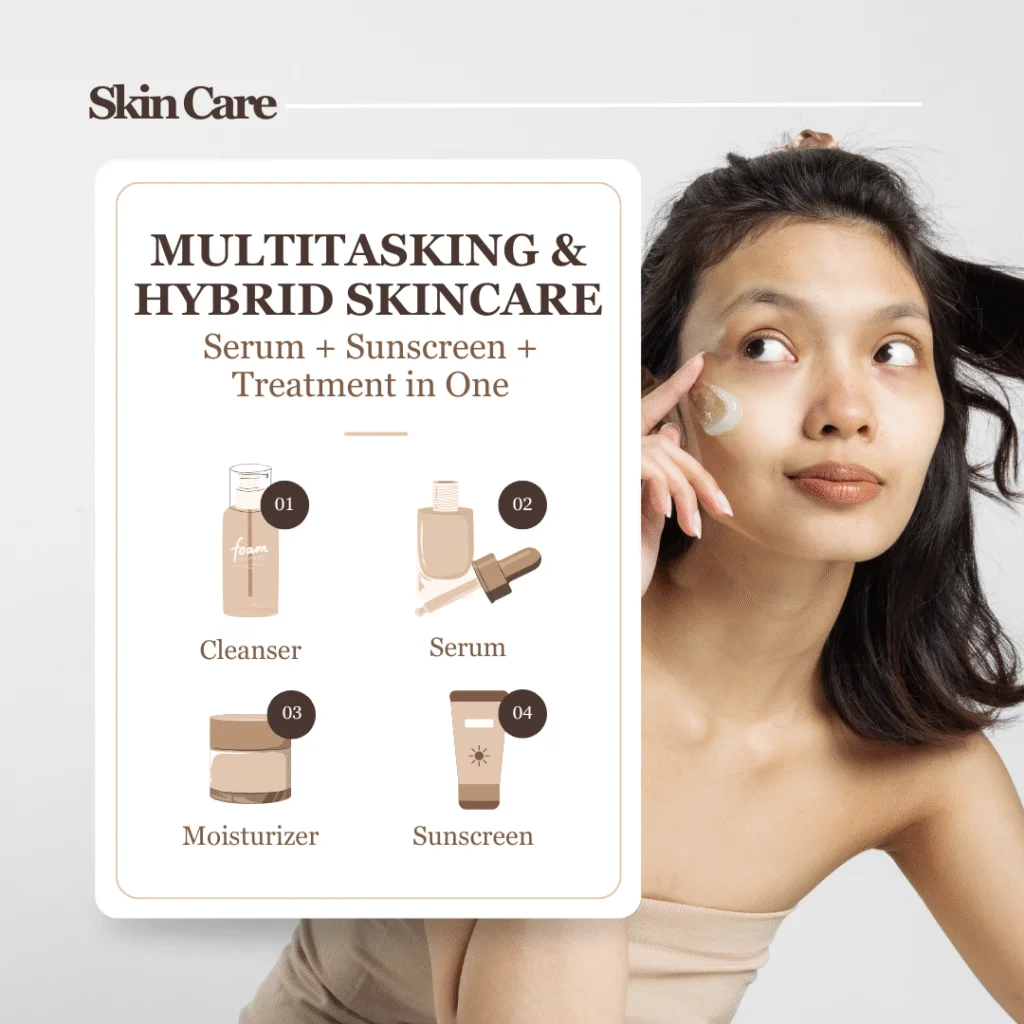
Why Multi-Tasking Skincare Makes So Much Sense
1. Saves Time (and Steps)
One of the biggest advantages of a well-formulated multitasker is the streamlining of your routine. Instead of applying a separate serum in the morning, then a sunscreen, then a treatment product, you apply one hybrid product. Less fuss, fewer steps — and hopefully fewer leftovers in the bathroom. As one guide notes: “In today’s busy world… we’re always looking for those little shortcuts that help us get effective results without spending much time.” Face the Future
2. Encourages Consistency
Let’s face it: if your routine is too long or complicated, you’re more likely to skip steps. A hybrid product reduces the barrier to daily use. When skincare is simple and effective, staying consistent becomes easier.
3. Combined Protection + Treatment
One of the smartest combinations: skincare actives (brightening, anti-ageing, antioxidant) + sun protection. Since UV exposure is the biggest external driver of skin ageing, weaving in sunscreen into a treatment product makes a lot of sense. Many hybrid formulations now deliver broad-spectrum UV protection alongside serums that target pigmentation, fine lines or dullness.
4. Travel- & Lifestyle-Friendly
For those on the go — frequent travelers, busy professionals, minimalists — a multitasking product means fewer bottles, lighter bags, hassle-free morning routines. It also means fewer chances of skipping essential protection because you forgot one step.
What “Hybrid Skincare” Actually Means
When brands say “hybrid,” it can mean a few different things:
- Skincare + Makeup: Products that behave like makeup (tint, coverage) but also contain skincare actives (e.g., peptides, hyaluronic acid). For example, tinted moisturisers with built-in SPF and brightening ingredients. Sephora+1
- Serum + SPF + Treatment: A formula that treats your skin (serum), protects your skin (sunscreen), and may also act as your everyday product (so fewer complementary products needed).
- Multi-Concern Serum: A skincare product that addresses more than one skin concern (e.g., hydration + brightening + barrier-repair) in one step, although not always combining makeup or SPF. Face the Future
When you see a product marketed as a “serum + sunscreen + treatment,” it specifically means it’s designed to:
- deliver active performance (serum effect: treat lines, pigmentation, texture)
- provide sun protection (SPF UVA/UVB coverage)
- act as your daily go-to product (treatment in the sense of preventive + corrective)
The appeal is obvious: fewer bottles, less decision-making, and combined benefits.
The Key Features to Look For in a Hybrid Serum + Sunscreen + Treatment Product
To reap the full benefits of a hybrid product, you’ll want to evaluate it carefully. Not all multitaskers perform equally across all promised functions. Here are the markers of a good one:
1. Reliable Broad-Spectrum SPF
Since one of the roles is sun protection, you want a formula that clearly states broad-spectrum (UVA + UVB) coverage and has been tested appropriately. Without that, the “sunscreen” part becomes a weak link.
2. Meaningful Active Ingredients
If the product calls itself a “treatment” or “serum,” it should contain clinically-sound actives in effective concentrations. For example:
- Niacinamide or vitamin B3 for barrier support & brightening
- Peptides or retinol derivatives for anti-ageing
- Antioxidants (vitamin C, E) for protection
- Hyaluronic acid for hydration
Just marketing “serum” isn’t enough — you want evidence of ingredient efficacy. For example, one review noted a hybrid tinted skin-serum + SPF product that included 2% niacinamide and 0.5% bisabolol (a soothing botanical) — which was praised for actually functioning as a serum, not just a buzz-word. Poosh
3. Lightweight, Comfortable Texture
Because you’re combining multiple functions, the texture must be comfortable enough for daily use — no heavy white cast sunscreens or sticky formula that makes you dread application. Texture and feel matter if you’re going to use it consistently.
4. Appropriate for Your Skin Tone & Type
If the product is tinted (or has a colour component), check for shade range and suitability for your undertone. If you have oily or acne-prone skin, make sure the formula is non-comedogenic. If you have sensitive skin, ingredients like fragrance or heavy perfumes might be a concern.
5. Good Packaging & Delivery
Since the formula has to deliver both actives and SPF, packaging matters. Airless pump bottles or opaque tubes help preserve sensitive actives (vitamin C, peptides) and ensure stability. Also, check whether the amount you need to apply for full SPF coverage is realistic in your routine.
6. Clear Usage Instructions
Because it combines multiple roles, you’ll want clear guidance: how much to use, how it layers (if you’re layering something else), whether re-application is needed for the sunscreen part (many still require you reapply for full protection over long sun exposure).
Why Now? The Context of the Skincare Market
The hybrid product trend isn’t a gimmick — it reflects several converging factors:
- Consumers are demanding simpler routines but smarter products.
- Bigger focus on daily sun protection: a growing awareness that UV damage is the #1 cause of skin ageing.
- The blurring of lines between skincare and makeup: as products evolve, a “tinted serum with SPF” becomes a viable everyday product. Vogue
- Formulation science has matured: we now have smaller-dose effective actives, more stable SPF systems, and textures that feel more like skincare than “sunscreen paste.”
In short: you can now have skincare that protects, treats and simplifies — and brands are answering that demand.
A Closer Look: What a Hybrid Serum + Sunscreen + Treatment Delivers
Let’s break down what a strong hybrid product gives you, and why each component matters.
A. Protection – Sunscreen Component
- UVA rays cause long-term ageing (wrinkles, sagging) and UVB rays cause burning, pigmentation. A broad-spectrum product defends both.
- Daily protection is essential even if you’re mostly indoors (UV passes through windows, there’s incidental exposure).
- When sunscreen is built into your daily treatment product, you’re more likely to apply it every day, not just “when going out.”
- Reapplication is still key if you’re in strong sun; the hybrid may replace your morning step but not the midday re-application if needed.
B. Treatment – Serum/Active Component
- Ingredients like niacinamide, peptides, retinol or its derivatives, antioxidants tackle specific concerns: pigmentation, fine lines, texture, dullness.
- Having those actives when combined with sun protection means you’re addressing causes and effects.
- Example: If you have uneven tone from sun damage, the sunscreen stops new damage while the serum helps fade what’s already there.
C. Daily Performance – Ease, Texture & Lifestyle Fit
- A formula that feels lightweight, sits well under makeup or alone, and doesn’t irritate skin will get daily use.
- Good texture means you’re more likely to apply properly (enough amount, even spread).
- Fit for busy mornings, minimalist routines, or travel-friendly setups.
How to Incorporate a Hybrid Into Your Routine
If you’re ready to try a serum + sunscreen + treatment hybrid, here’s a suggested usage guide:
- Morning: Cleanse, any pre-serum if you use (optional), then apply your hybrid. Ensure you apply a sufficient amount for the sunscreen part (brands usually state recommended grams or pumps).
- Layering: If you still need a separate moisturizer (dry skin, winter), you can apply it after the hybrid once the hybrid has absorbed. If the hybrid already serves as your moisturizer, you can skip.
- Makeup: If you wear makeup, you can apply it on top of the hybrid once it has set (usually 1-2 minutes).
- Midday Re-application: If you’ll be in direct sun for a long time, you’ll still need to re-apply sunscreen. You can use your hybrid at first and then a dedicated sunscreen later, or a powder- or spray-based re-application.
- Evening: Remove the hybrid with a gentle cleanser (double cleanse if you wear makeup or you use SPF formulations), and then apply your usual nighttime serum/moisturiser.
Which Skin Types & Concerns Benefit Most?
Here are some general guidelines:
- Normal to combination skin: Ideal candidates — a hybrid covers protection, treatment and feel without excessive layering.
- Busy professionals/Minimalists: If you want to simplify your routine but not compromise on performance.
- Sun-exposed or outdoor lifestyle: If you’re worried about UV exposure + ageing + pigmentation, a hybrid can help you consistently cover daily protection while treating damage.
- Travellers: Less luggage, fewer bottles, one morning step.
- But caution for:
- Very oily or acne-prone skin: make sure the product is non-comedogenic; consider if you still need an oil-control product or separate sunscreen with matte finish.
- Very dry skin: If your hybrid doesn’t deliver enough hydration, you might still need a separate rich moisturiser.
- Sensitive skin: Check the ingredient list – fragrance, essential oils, high concentrations of actives can irritate.
- Very high UV exposure (beach, mountain, midday sun): You may still need a dedicated high-SPF sunscreen on top of your hybrid for full protection.
Common Misconceptions & Pitfalls
- “Hybrids can replace everything” – Not entirely. Some experts caution that while these products are valuable, they don’t always equal a full skincare routine when you have serious concerns. Vogue
- “One bottle means less sunscreen required” – You still need to apply the proper dose for the SPF to work. Brands often recommend ~¼ teaspoon for face & neck; check instructions.
- All hybrids are created equal – Some may excel at “serum” part but compromise SPF; others may have good SPF but weak active dose. Always read the claims and, if available, test the texture/feel.
- Tinted hybrids suit all tones automatically – Shade range and undertones matter. One “universal” shade may not match everyone.
Real-World Benefits: What Users Report
Many users of hybrid formulas report the following benefits:
- Less time spent in the morning routine.
- A more consistent routine because fewer steps means fewer skipped days.
- Noticeable improvement in skin tone, texture or brightness when the treatment actives are sufficient.
- No white cast or heavy feel despite the SPF.
- Better compatibility under makeup (if you wear it) because the hybrid acts as a “prep + protect” product.
In one article, a user described how a combined tinted serum + SPF product became their only morning step on many days because it delivered on both feel and function. Poosh
What to Expect and When
- Short-Term (first few days to a week): Improved texture and comfort; ease of routine; smoother application.
- Medium-Term (4-8 weeks): If the treatment actives are strong and suitable for you, you may notice fewer fine lines, evening of tone, improved brightness.
- Long-Term (3+ months): Reduced appearance of sun-induced pigmentation, slower development of new sun damage (assuming consistent use) and a more resilient skin barrier.
Regular usage is key — the benefits of actives accumulate over time, and the sunscreen component only works if used consistently.
Final Thoughts & Key Takeaways
The concept of a multi-tasking, hybrid skincare product – one that acts as a serum, as a sunscreen, and as a treatment – is a powerful evolution in the beauty world. It responds directly to modern demands: fewer steps, smarter routines, and high performance.
When selecting such a product, focus on:
- credible broad-spectrum SPF;
- meaningful treatment actives;
- comfortable texture and daily usability;
- suitability for your skin type and lifestyle.
If you get all those boxes ticked, the payoff could be substantial: easier routines, better compliance, and effective skin care that protects and treats. In an era where time is precious, and skin exposure to UV — pollution — stress is high, a hybrid product offers a compelling solution.
If you like, I can draft a version of this article that is specifically tailored to your brand/product — with customised ingredient highlights, unique value propositions, and a localised tone for your market (such as Pakistan/Asia). Would you like me to create that?