
INTRODUCTION
Hypochlorous acid spray for skin has become an increasingly visible skincare trend in 2026, attracting attention from people looking for simple ways to care for blemish-prone, irritated, or sensitive skin. Unlike complicated routines built around multiple serums and exfoliating treatments, this lightweight facial mist is generally marketed as a convenient addition to everyday skincare.
The ingredient has a scientific background, too. Hypochlorous acid, commonly abbreviated as HOCl, is a substance the human immune system produces naturally as part of its defense against microorganisms. Skincare products use carefully formulated solutions containing this ingredient for specific topical applications.
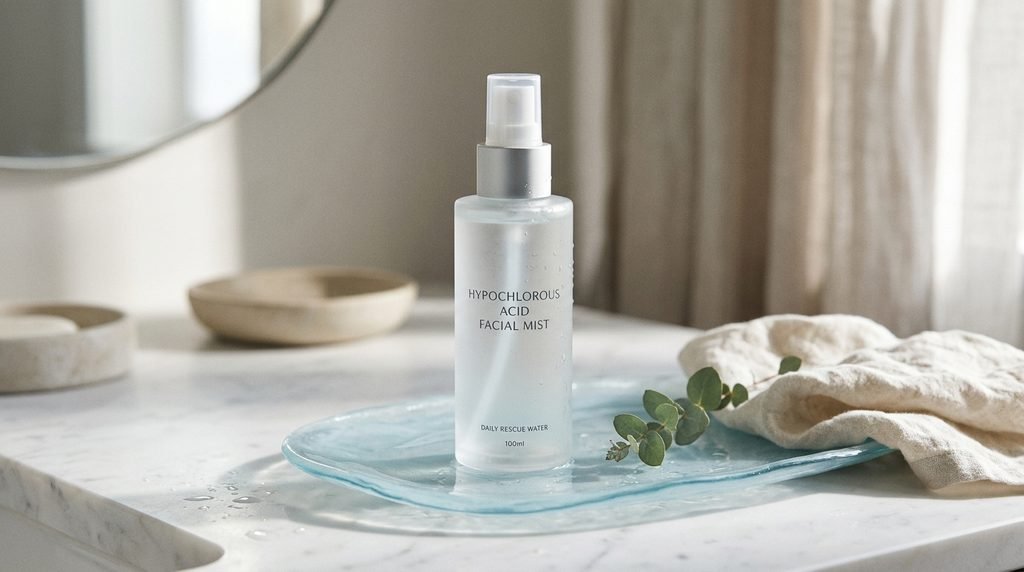
However, popularity does not automatically mean that every product delivers the same results. Research involving wound care and certain dermatological applications should not be interpreted as proof that every cosmetic spray treats acne, eczema, redness, or other skin conditions.
This guide explains what hypochlorous acid is, how it works, its potential skincare benefits, how to use it, and the precautions worth knowing before adding it to your routine.
Whether you are exploring a new facial mist or trying to simplify your skincare routine, understanding the ingredient can help you make a more informed decision.
What Is Hypochlorous Acid?
Hypochlorous acid is a weak acid with antimicrobial properties. The body naturally produces it through immune-system activity, where it contributes to the body’s response to microorganisms.
In skincare and dermatology, hypochlorous acid is used in certain topical formulations designed for specific skin-care or wound-care purposes.
Commercial products may contain stabilized hypochlorous acid in a water-based solution. The formulation, concentration, pH, manufacturing process, and storage conditions can influence product stability and performance.
One important distinction is that hypochlorous acid skincare spray is not the same as household bleach or a general-purpose disinfectant. Products intended for cleaning surfaces should never be substituted for products formulated and labeled for facial use.
Why Is Hypochlorous Acid Trending in 2026?
Several factors help explain the ingredient’s growing visibility.
First, consumers are increasingly interested in skincare ingredients rather than relying exclusively on brand names. Industry trend reports identify ingredient-focused searches as an important part of beauty discovery. Hypochlorous acid has also appeared in coverage of emerging skincare trends. <Cite refs={[“turn871780search0″,”turn871780search3”]}/>
Second, the spray format is convenient. It can be carried in a gym bag or used as part of a simple routine, provided the product label permits the intended use.
Third, the ingredient has established antimicrobial properties, although the clinical benefits depend on the particular formulation and application. This scientific foundation makes it a subject of interest in dermatology.
The important point is to separate promising uses from exaggerated marketing claims. A trending ingredient can be worth understanding without being a necessary purchase for everyone.
How Does Hypochlorous Acid Work on Skin?
Hypochlorous acid is involved in the body’s natural immune response. When produced by certain immune cells, it contributes to antimicrobial activity.
In topical products, appropriately formulated hypochlorous acid solutions may help reduce microbial contamination on the intended application site. Research has investigated its use in wound care and several dermatological settings. However, the results cannot automatically be applied to every consumer facial mist. <Cite refs={[“turn659693search6″,”turn659693search9”]}/>
The way a product performs depends on several factors:
- Formulation: Different products can have different concentrations, pH levels, and stabilizing systems.
- Stability: The active solution can change over time, particularly when storage conditions are unsuitable.
- Intended use: A product designed for wound care may have different instructions from a cosmetic facial mist.
- Individual skin response: Skin sensitivity and existing conditions can influence whether a product is suitable.
Hypochlorous acid should not be described as a universal acne treatment or a guaranteed way to repair the skin barrier. Its potential role is more specific, and evidence for individual cosmetic claims varies.
Benefits of Hypochlorous Acid Spray for Skin
1. Supports Skin Hygiene
One potential benefit of hypochlorous acid is its antimicrobial activity. Certain formulations are designed to support skin cleansing or hygiene in specific circumstances.
This may be appealing to people who want a convenient product for their skincare routine after exercise or during travel.
However, a facial mist should not replace ordinary cleansing when the skin has accumulated sweat, sunscreen, oil, or dirt. Nor should a cosmetic spray be considered a substitute for appropriate medical care when an infection is suspected.
Choose a product specifically labeled for the intended skin application and follow its directions.
2. May Help Support the Care of Irritated Skin
Hypochlorous acid is being studied and used in selected dermatological applications because of its antimicrobial and potentially inflammation-modulating properties.
Some evidence relates to wound care and particular skin conditions, but this does not establish that all over-the-counter facial sprays relieve irritation. <Cite refs={[“turn659693search1″,”turn659693search6”]}/>
If you have reactive skin, introduce any new product cautiously. A fragrance-free formula may be preferable if fragrance is a known trigger for you.
Persistent burning, swelling, itching, or worsening redness should not be dismissed as a normal adjustment period.
3. May Be Useful in Some Acne-Care Routines
People often search for hypochlorous acid spray for acne because the ingredient has antimicrobial properties.
There is limited formulation-specific clinical research involving inflammatory acne, but the evidence is not strong enough to conclude that all facial sprays treat acne effectively. A study of one formulation does not prove that every product containing hypochlorous acid will produce the same result. <Cite refs={[“turn659693search0″,”turn659693search5”]}/>
For acne-prone skin, a suitable spray may be considered an optional supporting product rather than the foundation of treatment.
Established acne treatments, such as benzoyl peroxide or topical retinoids, have more established roles for particular forms of acne. The right choice depends on your skin, the type of acne, and advice from a qualified healthcare professional when needed.
4. Offers a Convenient, Lightweight Format
Most facial sprays are easy to apply and do not have the rich texture associated with creams or ointments.
For people who dislike heavy skincare products, this format may be attractive. It can also fit into a routine with a cleanser, moisturizer, and sunscreen without necessarily requiring several additional layers.
Convenience, however, is not the same as effectiveness. A spray that feels refreshing should not be assumed to provide deep hydration or long-lasting barrier support unless its formulation and evidence support those claims.
5. May Complement Selected Dermatological Care
Hypochlorous acid formulations have been investigated for wound care and other clinical applications. Some products are designed specifically for professional or medical use. <Cite refs={[“turn659693search1″,”turn659693search25”]}/>
This does not mean that a consumer facial mist can replace prescribed treatment or should be applied to an open wound without appropriate instructions.
If a clinician recommends a particular product, follow the instructions for that formulation rather than assuming all hypochlorous acid products are interchangeable.
Who Should Use Hypochlorous Acid Spray?
Hypochlorous acid spray may be worth considering if you want a lightweight product designed for skin hygiene or a specific supporting role in your skincare routine.
Potential users include:
- People looking for a simple facial mist.
- Individuals who prefer lightweight products over heavy creams.
- People interested in skincare products formulated for particular hygiene needs.
- Consumers who want to explore ingredient-focused skincare without adding multiple active serums.
It may not be necessary if your existing routine already works well.
People with persistent acne, rosacea, eczema, unexplained rashes, or other ongoing skin problems should avoid relying on a viral product as their main treatment. A dermatologist can help identify the underlying issue and recommend an appropriate approach.
How to Use Hypochlorous Acid Spray in Your Skincare Routine
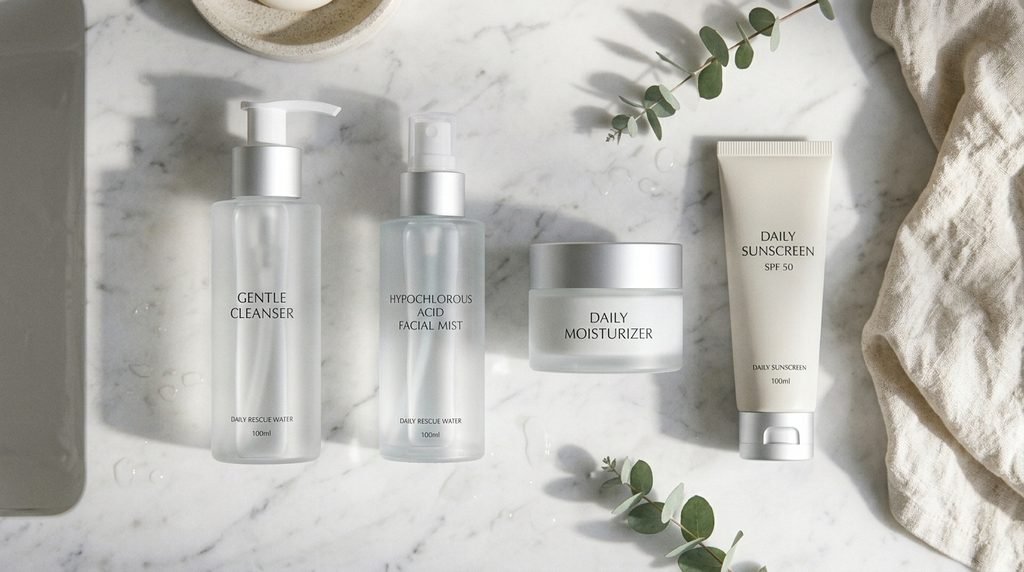
The correct method depends on the product label. The following routine is a general example for a facial mist explicitly intended for leave-on facial use.
Step 1: Cleanse Your Skin
Begin with a gentle cleanser suitable for your skin type. Use lukewarm water and avoid aggressive scrubbing.
Cleansing helps remove sweat, oil, sunscreen, and everyday debris. A spray should not be expected to perform every function of a cleanser.
Step 2: Apply the Spray According to Its Label
Follow the manufacturer’s instructions regarding application distance, amount, frequency, and whether the product should be rinsed off.
Keep the spray away from the eyes unless the product is specifically labeled for ocular use. Avoid inhaling the mist.
Step 3: Allow It to Dry if Directed
Some leave-on products instruct users to let the solution dry before applying additional skincare products. Others may provide different directions.
Follow the specific label rather than applying a universal waiting time to every formula.
Step 4: Apply Moisturizer
Use a moisturizer suited to your skin type.
Ingredients such as glycerin, ceramides, and hyaluronic acid can help support hydration in appropriate formulations. Hypochlorous acid spray should not automatically be treated as a replacement for moisturizer.
Step 5: Finish With Sunscreen in the Morning
Apply broad-spectrum sunscreen with SPF 30 or higher during the daytime, following its directions.
Sunscreen remains an important part of a daytime routine, particularly if you use other products that may increase sensitivity to sunlight.
How Often Should You Use It?
There is no single frequency that applies to every hypochlorous acid product.
Some labels permit repeated use, while others specify a particular schedule. Start according to the instructions, monitor your skin’s response, and avoid increasing use simply because a product is popular online.
If irritation develops or your skin condition worsens, stop using the product and seek professional advice if symptoms persist.
Hypochlorous Acid Spray for Different Skin Concerns
Hypochlorous Acid Spray for Oily Skin
Oily skin produces more sebum, which can contribute to a shiny appearance and clogged pores.
Hypochlorous acid spray is not a proven oil-control treatment, and it should not replace a cleanser or a suitable acne product. If your main concern is excess oil, consider a gentle cleansing routine and ingredients selected for your particular skin needs.
Hypochlorous Acid Spray for Sensitive Skin
Sensitive skin can react to fragrance, harsh cleansers, exfoliating acids, and other ingredients.
A simple, appropriately formulated spray may appeal to people who prefer minimal routines. Nevertheless, sensitive skin does not guarantee that a product will be tolerated.
Choose a formula intended for facial use, check its ingredients, and test it cautiously. Stop if it causes persistent irritation.
Hypochlorous Acid Spray for Acne-Prone Skin
For acne-prone skin, the key is to distinguish between a supporting product and a treatment that addresses acne itself.
Hypochlorous acid may have a role in selected applications, but evidence for consumer sprays remains limited and formulation-specific. Do not assume it will clear blackheads, prevent all breakouts, or remove acne scars.
If acne is painful, persistent, or leaving scars, a dermatologist can help identify treatments with better-established evidence.
Hypochlorous Acid Spray for Redness
Redness can result from many causes, including irritation, rosacea, allergic reactions, sun exposure, and other inflammatory conditions.
A product that helps in one situation may not help in another. Do not use a facial mist to self-treat persistent or unexplained redness without understanding its cause.
Seek medical advice if redness is accompanied by significant pain, swelling, blistering, or other concerning symptoms.
Hypochlorous Acid Spray After Exercise
Some people like carrying a facial mist for use after workouts.
If you use one, choose a product labeled for the intended skin application and follow its directions. When practical, gently cleanse sweat and accumulated products after exercising.
A mist is not a substitute for washing your face when it is dirty, and there is no guarantee that spraying it after every workout will prevent acne.
Hypochlorous Acid vs. Other Skincare Ingredients
| Ingredient | Main role | Important distinction |
|---|---|---|
| Hypochlorous acid | Antimicrobial activity in appropriate formulations | Evidence depends on the product and intended use |
| Salicylic acid | Exfoliation; useful in selected acne routines | Can cause dryness or irritation |
| Benzoyl peroxide | Established topical acne treatment | May irritate skin and bleach fabrics |
| Niacinamide | Supports barrier function and can help with selected concerns | Results depend on formulation and concentration |
| Hyaluronic acid | Helps attract and retain moisture | Primarily a hydration ingredient |
| Ceramides | Help support the skin barrier | Commonly used in moisturizers |
These ingredients are not direct substitutes for one another. Choosing between them depends on your goal.
For example, someone seeking hydration may benefit more from a moisturizer containing humectants and barrier-supporting ingredients. Someone managing acne may need an established acne treatment rather than relying on a facial mist.
Adding several active products at once can also make irritation harder to identify. A simple, consistent routine is often a better starting point than combining every trending ingredient.
How to Choose the Right Hypochlorous Acid Spray
Check the Intended Use
Look for a product explicitly labeled for facial or skin use. Do not use a household surface disinfectant on your face.
Products designed for wound care, medical procedures, and cosmetic use may have different instructions and intended purposes.
Review the Ingredient List
Check the full ingredient list for fragrance and other ingredients you know your skin does not tolerate.
A shorter ingredient list can make it easier to identify potential triggers, although simplicity alone does not guarantee safety or effectiveness.
Consider Formulation and Stability
Hypochlorous acid solutions can be sensitive to formulation and storage conditions. Scientific reviews highlight the importance of maintaining suitable pH and stability. <Cite refs={[“turn659693search6″,”turn659693search8”]}/>
Buy from a reputable seller, check the expiry date, and follow storage instructions. Do not assume that two sprays are equivalent simply because both list hypochlorous acid.
Avoid Unsupported Claims
Be cautious of products claiming to cure acne, eliminate all bacteria, permanently shrink pores, erase scars, or treat every skin condition.
A credible product description should explain the intended use without promising results that have not been established.
Consider Price and Practicality
A higher price does not automatically indicate a better formula.
Compare the amount of product, intended use, packaging, expiry information, and the manufacturer’s instructions. If your current skincare routine already meets your needs, you may not need to purchase another product.
Potential Side Effects and Safety Precautions
Hypochlorous acid products are used in several skin-care and medical settings, but safety depends on the formulation and its intended application. Findings from one medical product should not be generalized to every consumer spray. <Cite refs={[“turn659693search1″,”turn659693search5”]}/>
Keep these precautions in mind:
- Avoid eye exposure: Do not spray near the eyes unless the product is specifically labeled for that use.
- Do not ingest it: Facial sprays are not intended to be swallowed.
- Check the label: Follow directions for application, frequency, and storage.
- Do not mix products at home: Homemade mixtures can have unpredictable concentrations and stability.
- Stop if irritation occurs: Persistent burning, swelling, rash, or worsening redness warrants discontinuation and appropriate advice.
- Do not substitute cleaning products: Household disinfectants and skin-care products are not interchangeable.
People with diagnosed skin conditions or those using prescription treatments should consult a qualified healthcare professional if they are uncertain whether a product is suitable.
Severe swelling, difficulty breathing, or a rapidly developing serious reaction requires urgent medical attention.
Common Mistakes to Avoid
Expecting It to Replace Your Entire Routine
A facial mist does not automatically replace cleanser, moisturizer, sunscreen, or an appropriate treatment.
Build your routine around your actual skin needs rather than assuming one ingredient can do everything.
Using It Instead of Evidence-Based Acne Treatment
If acne is your main concern, a viral skincare ingredient may not provide enough treatment on its own.
Persistent or severe acne deserves an individualized treatment plan.
Assuming All Sprays Are Identical
Concentration, pH, stabilizers, packaging, and intended use can vary. Follow the instructions for the exact product you have purchased.
Ignoring Product Expiry and Storage
Incorrect storage may affect product stability. Do not use a product beyond its stated expiry or contrary to the manufacturer’s storage directions.
Copying Complicated Social Media Routines
Combining multiple exfoliants, retinoids, and other active ingredients can increase irritation risk. A recent report on skincare-related dermatological problems associated with social media routines highlights the importance of careful product selection. <Cite refs={[“turn871780news39″,”turn659693search5”]}/>
Introduce new products gradually and avoid changing your entire routine at once.
Frequently Asked Questions
1. What is hypochlorous acid spray for skin used for?
It is used in certain topical formulations for skin hygiene and specific skin-care or wound-care applications. The appropriate use depends on the product’s label and the available evidence for that formulation.
2. Is hypochlorous acid spray good for acne?
It may have a supporting role in selected situations, but evidence for consumer facial sprays is limited. It should not be considered a guaranteed acne treatment or a substitute for established therapies when those are needed.
3. Can I use hypochlorous acid spray every day?
Some products permit daily use, but frequency varies. Follow the label for your particular product and stop if irritation develops.
4. Can hypochlorous acid spray replace moisturizer?
No. A spray is not necessarily a moisturizer. If your skin needs hydration, continue using a suitable moisturizer unless a healthcare professional advises otherwise.
5. Is hypochlorous acid suitable for sensitive skin?
Some people may tolerate appropriately formulated products, but no ingredient is guaranteed to suit everyone. Check the label, introduce the product cautiously, and stop if your skin reacts.
6. Can I use it with niacinamide or hyaluronic acid?
These ingredients serve different purposes and may be included in the same broader routine. Follow each product’s instructions, introduce new products gradually, and watch for irritation rather than assuming every combination will suit your skin.
7. Should I use hypochlorous acid spray before or after moisturizer?
For a leave-on facial mist, the product instructions generally determine where it fits in your routine. If the label directs you to let it dry before applying other products, follow that guidance. There is no universal sequence for every formulation.
8. Can I spray hypochlorous acid over makeup?
Only do so if the product’s instructions support that use. A facial mist is not automatically a makeup-setting spray, and applying it over makeup should not replace proper cleansing.
9. Does hypochlorous acid remove acne scars or dark spots?
There is insufficient evidence to recommend consumer hypochlorous acid sprays as treatments for acne scars or pigmentation. These concerns may require different ingredients or professional treatments.
10. Is hypochlorous acid the same as bleach?
No. Although the substances are chemically related, their formulations and intended uses differ. Never apply household bleach or a general-purpose disinfectant to your face.
11. Can I make hypochlorous acid spray at home?
It is better to choose a properly manufactured product intended for skin use. Homemade solutions can have uncertain concentration, pH, stability, and contamination risks.
12. Is hypochlorous acid spray essential for a skincare routine?
No. It is an optional product, not a requirement. A suitable cleanser, moisturizer, and daytime sunscreen are more fundamental for many everyday routines.
Conclusion
Hypochlorous acid spray for skin is a noteworthy skincare trend in 2026 because it combines a convenient application format with an ingredient that has genuine antimicrobial properties and a history of investigation in dermatology.
Its potential benefits should still be understood in context. Evidence from wound care or a specific clinical formulation does not establish that every facial mist can treat acne, soothe every type of irritation, or replace conventional skincare products.
If you decide to try it, choose a reputable product intended for facial use, follow the label, store it correctly, and monitor your skin’s response. Keep the rest of your routine simple and use established treatments for persistent skin concerns.
Ultimately, the best skincare routine is not the one with the most trending ingredients. It is the one that suits your skin, supports its needs, and relies on realistic expectations and credible evidence.